Your agent did something weird again.
No crash. No error on a dashboard. Just confidently wrong, in front of someone who matters. A skill you made is to blame. And you can't say for sure why.
Meet the suspects.
- The model changed under it.
- The model got quietly nerfed.
- It ran on a model it was never rated for.
- The agent runtime updated.
- A skill up- or downstream changed its handoff.
- The general prompt shifted around it.
- New skills crowded out its context.
- A teammate “improved” it — or you forked it.
- It was never sharp: too vague, too broad, too long.
- Nothing. A 1-in-1,000 fluke.
Probably not your fault. Entirely your problem. And running it down means a long slog that can still end at “not sure.”
Meet the case file.
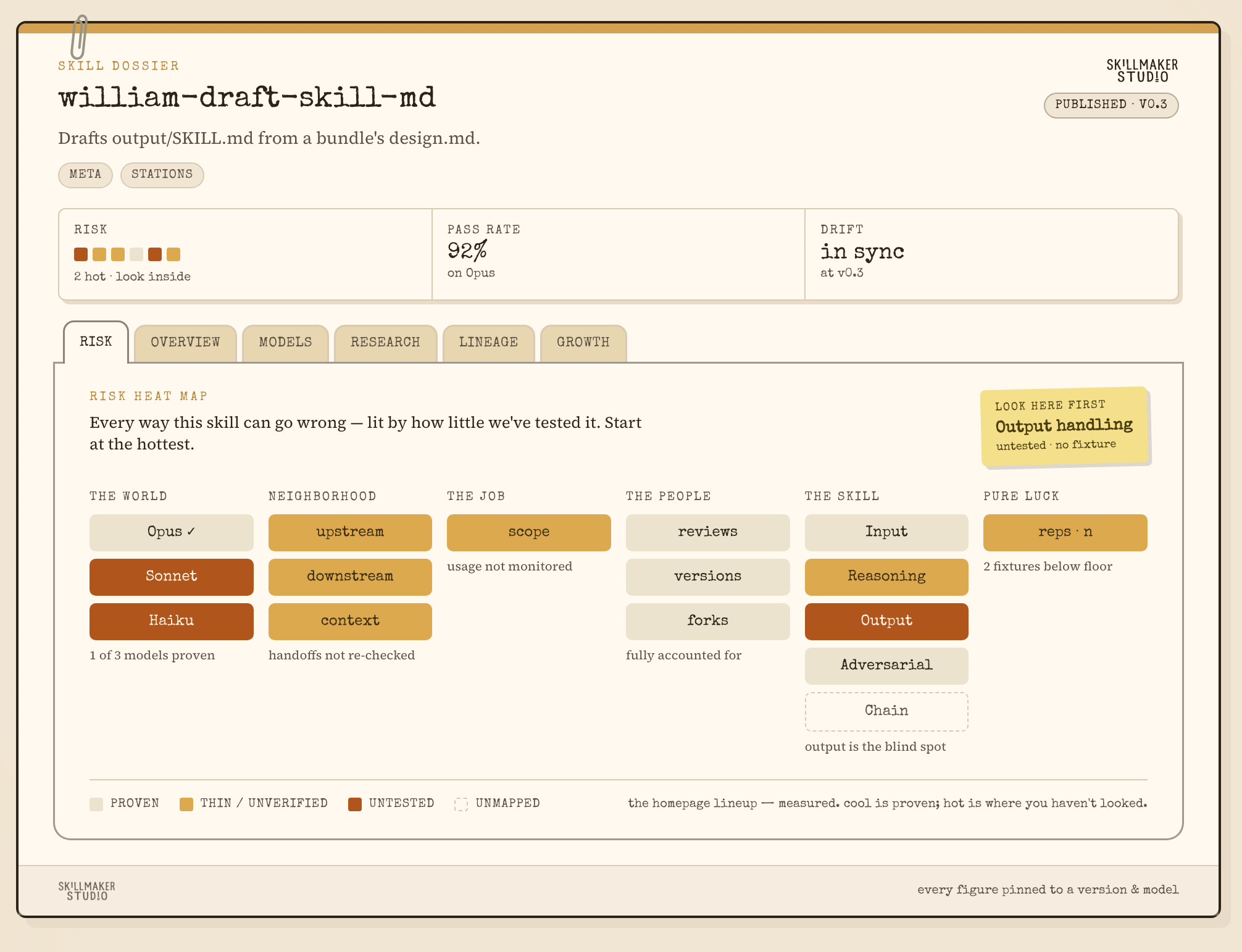
A skill made in Skillmaker never hands you a mystery — it hands you a case file: every suspect checked, evidence attached, likeliest first. You supply the judgment — the call, the clinching eval — and the Studio runs everything else, receipts included.
Embrace Your Inner Maker.
Skillmaker Studio is a build system for skills: research, design, and proof under every prompt, versioned in your git. Skills built this way rebuild in hours when the world moves.
Frame
The job, the boundaries, what counts as done.
Research
Evidence in; failure modes named.
Draft
A design with reasons — the design writes the SKILL.md.
Proof
What “good” means, as tests anyone can run.
Measure
Pass rate × confidence, pinned to version × model.
Gate
The numbers hold, or it doesn't ship.
Ship
Receipts frozen; everyone downstream flagged.
Every stage leaves its artifact in your git. When the world moves, you don't start at zero — you re-enter at the stage that slipped.
And that's just the first skill.
the whole repo
“Do this for all 89.”
Bulk-adopt the company repo in place — zero files moved. Every skill gets the same foundation and its own case file, and the whole portfolio lands on one board: gaps visible, receipts attached, dead weight obvious.
the growth program
“Same output, half the tokens.”
Every skill carries its own improvement loop. Fork it to a cheaper model and race it on the same fixtures. Tighten it and prove nothing regressed. New model drops? Re-run the proof and cash it in the same week.
the receiving dock
“Who knows where it's been.”
Nothing walks straight in. Every arriving skill — a teammate's fork, a community find, your own back from the wild — hits the dock first: re-verified against its proof, screened for anything malicious, its field lessons folded back in as new tests.
Every ask still carries the silent suffix: “…and don't break it.” Here that isn't a promise on vibes — it's the proof, re-run.
The secret is the trail.
Every number is pinned to the exact skill version and model that earned it. Every design choice is linked to the evidence behind it. So when a skill is stable but wrong — running clean, doing the job badly — you can see it, trace it, and fix the process, not just the prompt. And the culprit question — model, skill, teammate, you — becomes a lookup, not a fight.
Drift doesn't stop. It stops mattering.
You've already said it.
“AI is not a tool, it's a tiny Kafkaesque bureaucracy inside of your codebase.”
“Application prompts overfit the model they are using… Switch model, the prompt no longer produces the output you expect.”
“I keep it adhoc - models change so frequently that prompts are always broken all the time.”
Our Favorite Objections.
“Isn't this just an eval suite?”
Eval suites point at your outputs and hand back a number — they never hold your skill. Skillmaker does: design, proof, versions, receipts, lineage — one git-native bundle that ships with its evidence. Scoring is one thing it does, not the thing it is.
“Isn't this slower than just shipping it?”
Up front? Yes — writing down what good means takes real time. But you pay the hours either way: once here, on purpose, with a receipt — or every incident, in the dark.
“Do we have to restructure our repo?”
No. adopt works in place — 59/60 and 39/39 skills adopted cleanly on real public repos. Zero files moved.
“Where does my data go?”
Nowhere. Free, local, MIT-licensed, no account. It phones nothing home.
“And when you get acquired?”
Your receipts are plain files in your git history. If we vanished tomorrow, your evidence wouldn't. No account, no cloud, nothing to sunset.
“I'm not an evals person.”
You don't need to be. If your current process is a vibe check, that's a real start — our agents help you write it down in plain English and make it repeatable. You judge; they build.
Find out fast.
$ curl -fsSL https://skillmaker.studio/install.sh | sh
$ skillmaker adopt
Free. Local. MIT. Phones nothing home. On the repo you already have.
Want hands-on help? We're working with a small first round of design partners — open an issue and tell us what broke. Running skills as a team? Talk to us — we're designing the multi-player studio with a handful of companies.
We can't make your agent predictable — nobody can; that's what you hired it for. We can make sure nothing drifts silently, nothing fails anonymously, and nothing stays wrong. And the next time it goes weird, you won't sit there wondering if you're crazy. You'll look it up.
The only thing you risk is finding out.